Non-surgical treatments can tighten mildly to moderately loose neck skin, but the change is gradual and modest. Surgery still gives the most dramatic result. Non-invasive procedures give gradual, modest lifting, so the right choice depends on how much laxity you have and what you expect. This guide covers what causes loose neck skin, the main treatment types, honest results, safety checks for Canada, and what we offer at our Ottawa spa.
TL;DR
- Neck skin loosens from genetics, hormones, sun exposure and smoking. You can slow it, but you can’t fully reverse it with creams or exercises.
- Radiofrequency, microfocused ultrasound and lasers are the main non-surgical options. Each gives gradual, modest tightening over weeks to months.
- Significant sagging that needs skin removed is a surgical problem. A consultation should tell you honestly which side of the line you are on.
- In Canada, ask about the device’s Health Canada licensing, the practitioner’s training and the full cost of a course of treatments.
- At Nakota MediSpa in Ottawa, TriPollar Ultra Lift for face and neck is $275 per session.
Table of Contents
- Why neck skin loosens
- What results to expect from non-surgical tightening
- The main non-surgical options compared
- Radiofrequency tightening at Nakota MediSpa
- What creams, exercises and skincare can and can’t do
- When surgery is the better answer
- Safety checks for treatment in Canada
- Our perspective
- Book neck tightening in Ottawa
- What a realistic plan looks like
- FAQ
- Sources
Why neck skin loosens
The neck is one of the first places to show age. Its skin is thinner than the face, and it moves constantly. Research on neck ageing separates the causes into two groups: intrinsic factors such as genetics and hormonal change, and extrinsic factors such as UV exposure and smoking. Over time collagen and elastin decline, the skin loses its recoil, and it begins to crepe, fold and hang.
That paper also points to the limit of non-surgical care. Moderate-to-severe laxity, where a lot of skin would have to be removed, is best treated surgically. Muscle bands, fat under the chin and bone structure also shape the neck. A skin-tightening treatment only addresses the skin itself.
Can sagging neck skin be reversed?
Not fully. You can improve firmness and texture, and you can slow further damage. The sun is the one factor you control every day. The Canadian Dermatology Association says a daily broad-spectrum SPF 30 sunscreen and other sun-protection habits help prevent photoageing. Apply it to your neck and chest, not just your face.
What results to expect from non-surgical tightening
The honest answer is subtle. Clinicians reviewing radiofrequency say that non-ablative results are often modest and less predictable than surgical excision. They stress choosing the right patient and managing expectations as the most important steps in a consultation.
In practice, that means:
- Best candidates: mild to moderate laxity, fine crepey lines, early “softening” of the jawline and neck.
- Poorer candidates: pronounced hanging skin, visible vertical bands, heavy fullness under the chin.
- Timing: collagen remodelling is slow. Some treatments show their effect over two to three months, and most protocols use a course of sessions rather than one visit.
- Maintenance: ageing continues, so results are kept up with occasional top-ups and sun protection.
If a provider promises a surgical lift from a device, be cautious.
The main non-surgical options compared
| Treatment type | How it works | What the evidence shows | Main risks |
|---|---|---|---|
| Radiofrequency (RF) | Electromagnetic energy heats the dermis and deeper tissue to prompt collagen contraction and new collagen | Works across skin types because it interacts minimally with melanin; 247-patient study of multimodal RF: significant objective improvement, 93% satisfied | Heat-related injury if poorly done; in that study, swelling beyond 6 weeks and rare nerve injury |
| Microfocused ultrasound | Focused thermal energy at set depths creates small coagulation zones | Firmer skin over 2 to 3 months; 93% satisfactory outcomes at one year in lower face and neck work | Discomfort, redness, swelling, occasional bruising; rarely pigment change or numbness |
| Non-ablative laser | Stimulates collagen without removing the top skin layer | Shorter recovery, but generally more modest tightening than ablative lasers | Mild redness and warmth |
| Ablative fractional CO2 laser | Removes microscopic columns of skin to resurface and tighten | Has improved laxity, texture, jowling, pigment and wrinkles | Redness, infection, scarring, oozing, pigment change |
| Surgery | Removes and repositions skin and tissue | Most dramatic result | Surgical risks and recovery |
Two points stand out. First, RF devices differ in precision and depth: monopolar, multipolar, fractional and even internal-electrode devices exist, so “radiofrequency” is a family, not one treatment. Second, the neck heals more slowly than the face. Health Canada notes that its thinner dermis and fewer oil glands can delay healing after ablative laser, which is why conservative settings and follow-up matter.
Will CO2 laser tighten a turkey neck?
It can improve laxity and texture, and it is among the stronger non-surgical options for skin quality. It also carries the most downtime and the highest risk of the options above, particularly on a neck. It suits people willing to accept recovery time and who have found a practitioner experienced with neck skin. It is a medical procedure, so see a physician or dermatologist for it.
Radiofrequency tightening at Nakota MediSpa
We offer TriPollar radiofrequency skin tightening in Ottawa. For the neck, the relevant treatment is the TriPollar Ultra Lift for face and neck. Our published prices are:
| Treatment | Price |
|---|---|
| TriPollar Lift, full face | $225 |
| TriPollar Ultra Lift, face and neck | $275 |
| TriPollar eye-under treatment or eyebrow lift | $100 |
Treating face and neck together has a practical logic. A tightened jawline looks odd above a neck that has been ignored, and the skin on both areas ages by the same mechanisms. If you want to understand what radiofrequency can and can’t do before you book, our radiofrequency facial guide explains it plainly.
What we won’t do is promise a surgical lift. The research above is clear that RF gives gradual, modest change. We tell clients that at the consultation, and if your neck needs more than we can offer, we say so.
Where micro-needling fits
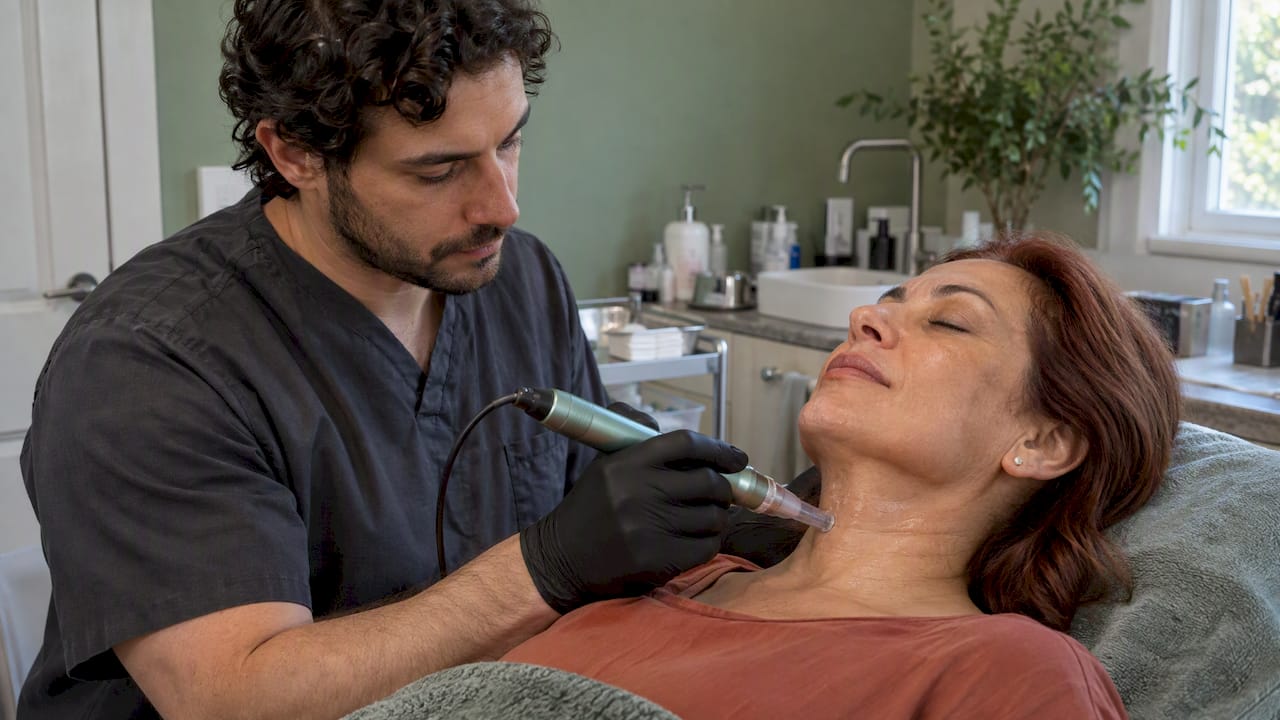
Micro-needling, or collagen induction therapy, doesn’t tighten the way heat-based devices do. It creates tiny controlled channels in the skin to prompt repair and new collagen, and it is used to improve texture and fine lines. Some clients pair it with a tightening course for crepey neck skin. Our collagen induction therapy is $350 per session. Ask us at the consultation whether it makes sense for your neck.
What creams, exercises and skincare can and can’t do
Neck creams can hydrate and soften the look of crepey skin, and that is a real benefit. They do not rebuild collagen deep enough to pull loose skin taut. Exercises may strengthen the muscles of the neck, but they don’t remove excess skin, and in some cases the muscle bands are part of what you see. Neither is a substitute for a procedure when laxity is moderate.
What does help, and costs little:
- Sunscreen daily on neck and chest, as above.
- Not smoking, which is an established extrinsic cause of neck ageing.
- Gentle moisturizing so the skin stays comfortable and smooth.
- Posture awareness, since constant forward head tilt deepens horizontal neck lines for many people.
The last point is common clinical observation, not a finding we can cite, so treat it as a habit worth trying rather than a proven fix.
When surgery is the better answer
Choose a surgical consultation first if you have heavy, hanging skin, strong vertical bands, or a neck you could pinch several centimetres. Non-surgical treatment will disappoint you in that situation, and money spent on a long course of sessions is better held for the right procedure. A plastic surgeon or dermatologist can examine your anatomy and tell you which route fits. Many people in the mild-to-moderate range are well served by trying a non-invasive course first.
Safety checks for treatment in Canada
Energy-based treatments heat tissue, so safety is the first thing to check, not the last.
- Device licensing. Health Canada requires scientific evidence of an acceptable risk-benefit balance for energy-emitting devices used for therapeutic or cosmetic treatment when energy is central to the claimed effect. Ask the provider about the licence for the device they use.
- Temperature limits. For class III and IV devices, manufacturers must supply skin temperature testing under worst-case conditions. Skin temperatures above 45°C without sound scientific rationale are considered potentially unsafe by Health Canada. A good practitioner can explain how their device manages heat.
- Newer concerns. Health Canada has encouraged more vigilance and adverse-incident reporting around potential fat loss or nerve damage with some energy-based devices, such as RF microneedling.
- Your history. Tell the practitioner about implants, pacemakers, pregnancy, skin conditions, medications and previous reactions. Medical questions belong with your family doctor or dermatologist.
- Total cost. Ask how many sessions are typical, the price per session, and what top-ups cost.
Our perspective
We see many people who arrive having read promises of a non-surgical facelift. Our view is simpler. Tightening the neck without surgery is a gradual project, and it works best when the skin is mildly to moderately loose and you start before the problem is advanced.
We prefer to treat the face and neck as one unit, keep sessions comfortable, and be straight about what a course can achieve. Our spa is home-based, which means private, unhurried appointments rather than a clinic waiting room. We operate as a Health Canada licensed spa, and we choose technologies with care.
If you need a surgeon, we will tell you at the consultation. If you want a non-invasive route, we will show you what is realistic. Your skin should look like yours, only firmer and fresher.
— Andy
Book neck tightening in Ottawa
Our TriPollar Ultra Lift treats face and neck for $275 per session. We begin with a conversation about your skin, goals and history, then plan a course that fits.
See the details and book on our TriPollar skin tightening page, or start at the Nakota MediSpa home page.
What a realistic plan looks like
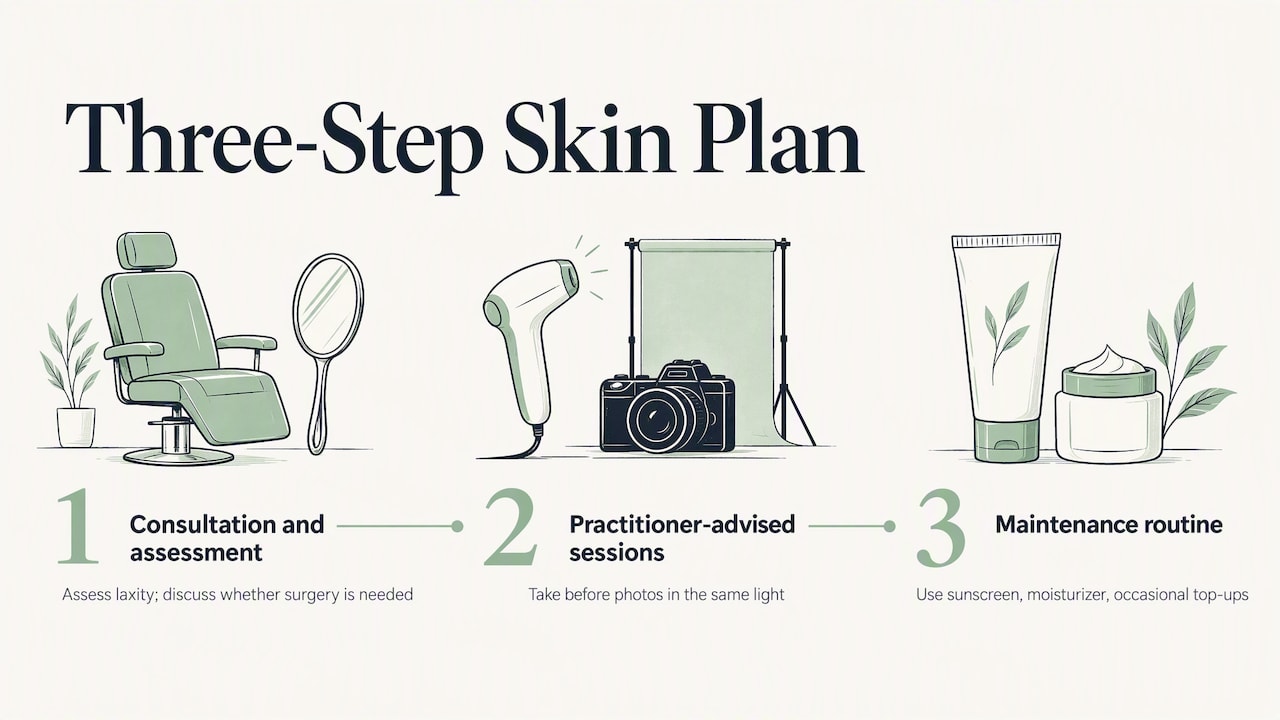
A sensible plan has three steps. First, a consultation to assess how loose the skin is and whether surgery should be discussed. Second, a series of sessions, spaced as your practitioner advises, with photos taken in the same light before you start so you can judge progress honestly. Third, a maintenance routine: sunscreen, moisturizer and an occasional top-up when you notice the change fading.
Expect to judge results over weeks and months, not days. Collagen remodelling takes time, and some device types show full effect only after two to three months. Mild redness or warmth after a session is common with heat-based treatments, but swelling that lingers, numbness or blistering should be reported to your practitioner promptly.
FAQ
How can I tighten loose skin on my neck?
For mild to moderate looseness, a course of radiofrequency, microfocused ultrasound or laser treatment can give gradual firming. Daily sunscreen and not smoking protect the results. For heavy sagging, a surgical consultation is the better first step.
Can you tighten a saggy neck without surgery?
Yes, to a degree. Non-surgical treatments produce modest, gradual improvement, while surgery gives the most dramatic change. How much you gain depends on how loose the skin is and how your skin responds.
How many sessions will I need?
Most heat-based tightening is done as a course, not one visit, and results build over weeks to months. The exact number depends on your skin and the device. We set out a plan with you at the consultation.
Do neck creams or exercises work?
Creams can hydrate and smooth the surface, but they don’t tighten loose skin in any lasting way. Exercises may tone muscle but don’t remove excess skin. Sun protection is the most useful daily habit.
Is non-surgical neck tightening safe?
It is generally well tolerated when done by a trained practitioner with a properly licensed device. Risks include redness, swelling and, rarely, pigment change or nerve effects, depending on the technology. Ask about licensing, temperature control and your own medical history first.
Sources
- Neck Aging and Rejuvenation: A Balanced Approach (Wiley)
- Many ways to firm sagging skin (American Academy of Dermatology)
- The Use of Radiofrequency in Aesthetic Surgery (PMC)
- Health Product InfoWatch, January 2026 (Health Canada)
- A Dermatologist’s Guide to Nonsurgical Rejuvenation of the Neck and Jawline (JCAD)
- Noninvasive skin tightening: focus on new ultrasound techniques (PMC)
- Multimodal Radiofrequency Application for Lower Face and Neck (PubMed)
- Evaluation of Micro-Focused Ultrasound for Lifting and Tightening Neck Laxity (JDD)
- Risk of thermal harm from therapeutic and cosmetic devices (Health Canada)
- Photoaging (Canadian Dermatology Association)