
A personalized skincare routine starts with three things: a gentle cleanser, a moisturizer and a daily sunscreen. You then adjust the products and add treatments around your skin type, your goals and your climate. In Ottawa, that climate means dry winters and strong summer sun, so your routine should change with the seasons. Below you’ll find a practical way to build yours, what to add for aging skin, and when a professional treatment does what products can’t.
TL;DR
- Start with the basics: cleanser, moisturizer and a broad-spectrum sunscreen of SPF 30 or higher, every morning.
- Add only one new product at a time and give it a few weeks before judging it.
- Layer in order: cleanse, treat, moisturize, then sunscreen in the morning.
- More actives is not better. Piling on retinoids and exfoliants can irritate skin and make aging look worse.
- If products plateau, a spa treatment such as TriPollar, micro-needling or a peel can add what a bottle can’t.
Table of Contents
- Why “personalized” matters more than “complete”
- Step 1: Identify your skin type and your main goal
- Step 2: Build the foundation
- Step 3: Add one targeted treatment product
- Step 4: Layer in the right order
- A routine for aging skin
- Your skin type, your routine: quick examples
- When products aren’t enough
- Our perspective: a routine is a conversation, not a product list
- Book a consultation in Ottawa
- Keeping your routine going
- FAQ
- Sources
Why “personalized” matters more than “complete”
Most routines fail for one reason: they were built for someone else’s skin. Dermatologists consistently say there is no one-size-fits-all approach. A routine works when it matches your skin type (oily, dry, combination or sensitive) and a specific goal, such as managing acne or reducing signs of aging.
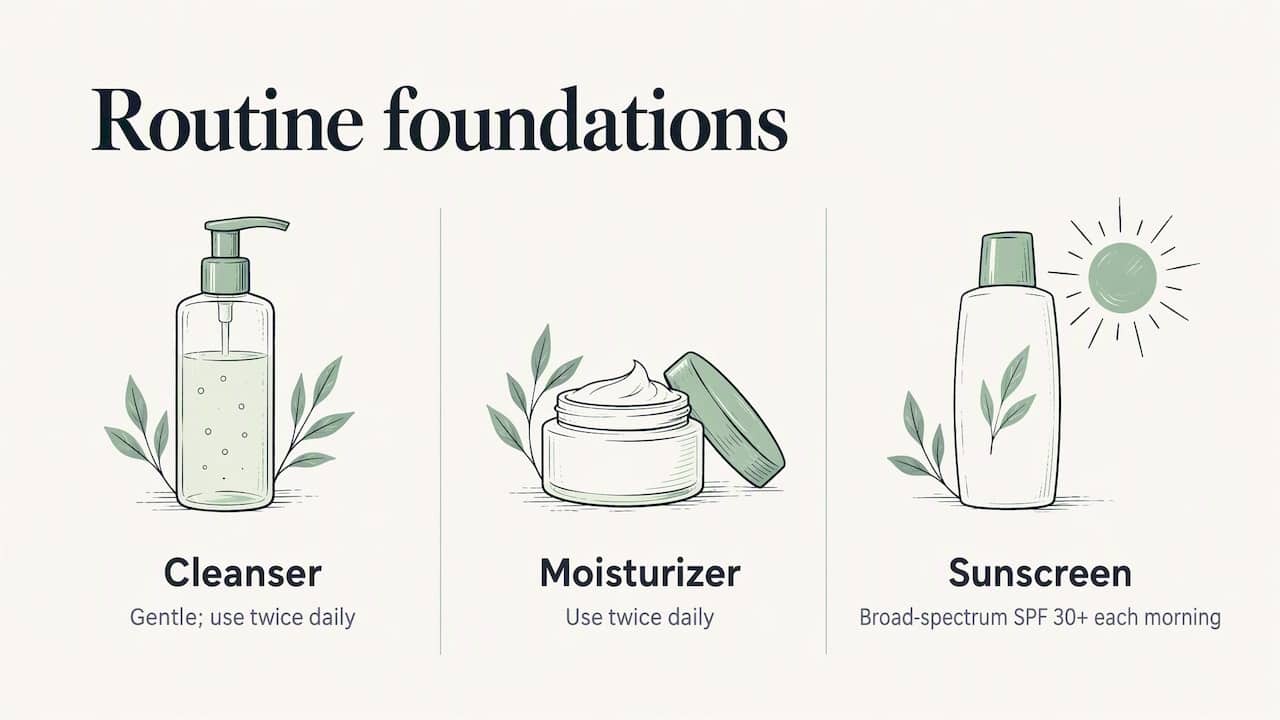
Personalized does not mean ten steps. The American Academy of Dermatology describes a basic effective routine as three foundations: a gentle cleanser, a moisturizer and a broad-spectrum sunscreen with SPF 30 or higher. Cleanser and moisturizer go on twice a day, and sunscreen goes on each morning. Everything else is an adjustment on top of that base.
Step 1: Identify your skin type and your main goal
Before buying anything, answer two questions honestly.
What does your skin do by midday?
- Oily: shine across the whole face, enlarged-looking pores, breakouts.
- Dry: tightness, flaking, rough patches, especially after washing.
- Combination: shine in the T-zone, dryness on the cheeks.
- Sensitive: stinging or redness with new products, weather or fragrance.
What is the one thing you most want to change? Pick a single priority for the next three months. Common ones are acne, dark spots, fine lines, loss of firmness, dullness, or a thinning hairline. A routine with one clear target is easier to judge than a routine trying to fix everything.
Your skin type can shift. Many people in Ottawa find their skin is oily in July and tight and flaky in February. If that’s you, keep a lighter and a richer moisturizer and swap them as the weather turns. Our seasonal guides cover that in more detail: 7 tips to help transition your skin this fall, winter skin care tips and 8 tips to transition from winter to summer skin.
Step 2: Build the foundation
Cleanser
Choose a gentle cleanser that leaves skin comfortable, not squeaky. Use lukewarm water. If your skin feels tight right after washing, the cleanser is too harsh for you. Oily skin can use a gel or foaming formula. Dry or sensitive skin usually does better with a cream or lotion cleanser.
Moisturizer
Moisturizer supports the skin barrier, and that matters in a heated-indoors, freezing-outdoors climate. Apply it while your skin is still slightly damp. Oily and acne-prone skin should look for lightweight, oil-free textures and should not skip moisturizer, because dehydrated skin can still break out. Dry skin can handle a richer cream, especially at night.
Sunscreen
Sunscreen is the single most useful anti-aging product you can use. The Canadian Dermatology Association advises a minimum SPF of 30 and a product labeled broad-spectrum, which helps protect against both UVB (burning) and UVA rays. UVA penetrates more deeply and drives premature aging. Sunscreen works best alongside shade, hats and clothing.
Use it in winter too, particularly on bright days with snow on the ground.
Step 3: Add one targeted treatment product
Once the foundation feels comfortable for two to four weeks, add a single active that matches your goal.
| Goal | Common active to ask about | Notes |
|---|---|---|
| Fine lines, texture | Retinoid (night only) | Light-sensitive, so pair with daily sunscreen |
| Dullness, rough texture | Gentle exfoliating acid | Don’t combine with a retinoid on the same night at first |
| Dark spots | Vitamin C in the morning, or a professional plan | High-concentration hydroquinone needs professional guidance in Canada |
| Dehydration | Hyaluronic acid serum | Apply under moisturizer |
| Acne | Ingredient chosen with a professional | See our acne treatment guide |
The pace matters. One board-certified dermatologist quoted in a recent beginner’s guide recommends introducing only one new product every two to four weeks, but you don’t need to rely on that rule alone: if you add three products at once and your face turns red, you won’t know which one caused it.
Retinoids: the careful way
Retinoids are powerful for anti-aging and cell turnover, but they make skin light-sensitive and should be used at night. Harvard Health describes starting slowly because overuse can cause significant peeling or redness. If your skin is reactive, talk to your family doctor or a dermatologist before starting one, especially if you have eczema, rosacea or a history of strong reactions.
Hydroquinone and Canadian rules
In Canada, Health Canada reminds consumers to consult a health professional before using high-concentration hydroquinone skin-lightening products. Don’t buy these online from unknown sellers. See a physician or dermatologist for persistent dark patches.
Step 4: Layer in the right order
Order affects how well products absorb and how well they work. The American Academy of Dermatology suggests a simple pattern: cleanse first, then treatments such as serums or retinoids, then moisturizer, and finally sunscreen in the morning.
Morning
- Rinse or cleanse gently.
- Antioxidant serum, if you use one.
- Moisturizer.
- Broad-spectrum sunscreen, SPF 30 or higher.
Evening
- Cleanse (and remove sunscreen thoroughly).
- Retinoid or other treatment. The same AAD guidance notes that retinoids can go on 20 to 30 minutes after cleansing, or after moisturizer if they are too drying.
- Moisturizer.
A useful habit: on retinoid nights, skip the exfoliating acid. Alternate nights instead of stacking.
A routine for aging skin
If you are searching for a routine for aging skin, the temptation is to buy every anti-aging product at once. That tends to backfire. The AAD warns that using too many products, especially more than one anti-aging product, may irritate skin and make the signs of aging more noticeable. The Cleveland Clinic makes a similar point about keeping everyday routines simple.
A sensible aging-skin routine looks like this:
- Morning: gentle cleanse, hydrating moisturizer, daily SPF 30 or higher.
- Night: cleanse, one active (usually a retinoid, introduced slowly), moisturizer.
- Weekly: a gentle exfoliation only if your skin tolerates it and you aren’t using a retinoid that night.
- Periodically: a professional treatment for the things creams struggle with, such as loss of firmness, deeper texture changes and sun damage.
The AAD notes that board-certified dermatologists provide clinical rejuvenation treatments that complement daily home care. Home care and in-person treatment are partners, not rivals.
Your skin type, your routine: quick examples
Oily or acne-prone: gel cleanser, oil-free moisturizer, lightweight sunscreen. Add one acne-targeting active only after a few weeks. Persistent or painful acne is a reason to see a doctor, not to buy more products.
Dry: cream cleanser, rich moisturizer applied on damp skin, sunscreen with moisturizing base. Add hyaluronic acid under your cream in winter.

Combination: a light moisturizer on the T-zone and a richer one on the cheeks is fine. You don’t need two full routines.
Sensitive: fragrance-free basics only. Add one product at a time and patch test on the inner forearm or behind the ear first.
When products aren’t enough
Products work on the surface. Some concerns respond better to a professional treatment, and that is where a personalized plan stops being a shopping list and becomes a program.
| Concern | Professional option | What it does |
|---|---|---|
| Loss of firmness, jawline and neck laxity | TriPollar radio-frequency skin tightening | Uses radio-frequency energy to tighten skin |
| Texture, fine lines, scarring | Micro-needling (collagen induction therapy) | Creates tiny controlled channels to stimulate the skin’s repair response |
| Dullness, congestion, uneven tone | OxyGeneo 3-in-1 facial or a chemical peel | Exfoliation, oxygenation and infusion of nourishing ingredients |
| Thinning hair | Mesotherapy and micro-needling with vitamins | Delivers actives to the scalp |
| Skin tags, warts and other benign lesions | Cryotherapy | Removes individual benign lesions |
For hair, a systematic review of mesotherapy in pattern hair loss found positive results in the cases it reviewed, with no significant side effects reported in the included trials. Reviews also describe microneedling and mesotherapy as emerging, minimally invasive options, often best when paired with standard hair-growth therapies. It is evidence worth discussing with a professional, not a guarantee.
Safety questions to ask any provider
Energy-based treatments deserve a careful look. Health Canada’s safety bulletin on radiofrequency microneedling lists potential risks such as burns, scarring, fat loss and nerve damage, and stresses the need for licensed devices and careful monitoring. Before any treatment, ask:
- Is the device licensed by Health Canada?
- Will there be a full consultation first, including your medical history and medications?
- What is the aftercare plan, and what should I avoid?
- Is this treatment right for my skin tone and condition, or should I see a physician first?
We answer all four before a first treatment, because that’s how care should work.
Our perspective: a routine is a conversation, not a product list
We run Nakota MediSpa from a private, home-based space in Ottawa, and that setting shapes how we work. There’s no rush between appointments, so the first visit is mostly talking: what your skin does through the year, what you use now, what you’ve tried and stopped, and what you want to see in three months.
Over and over, the most useful advice is subtraction. People arrive with a bathroom shelf of products and irritated skin. We simplify, protect the barrier, make sure sunscreen is daily, and only then talk about treatments. We use Health Canada licensed devices and focus on natural-ingredient protocols, and we won’t recommend a treatment your skin doesn’t need.
The treatments then fill specific gaps. TriPollar is for firmness. Micro-needling is for texture and, with vitamins, the scalp. OxyGeneo and peels are for radiance and congestion. Your home routine keeps those results going between visits.
— Andy
Book a consultation in Ottawa
If you’d like a routine built around your actual skin, start with a conversation. Our published prices for popular treatments:
- TriPollar Lift, full face: 225 CAD
- TriPollar Ultra Lift, face and neck: 275 CAD
- TriPollar eye under-treatment or eyebrow lift: 100 CAD
- Collagen induction therapy / micro-needling: 350 CAD
- OxyGeneo 3 in 1 Super Facial, back facial: from 185 CAD
- Cryotherapy for benign skin lesions: 25 to 40 CAD per lesion, plus a 75 CAD appointment fee
We also offer the OxyGeneo 3 in 1 Super Facial, a Noon chemical peel, mesotherapy and hair regrowth and rejuvenation. Contact us through our website for pricing and to book.

Keeping your routine going
A few habits make the difference between a routine that works for a month and one that works for years.
- Judge in weeks, not days. Give a new product several weeks unless it stings, burns or swells. Stop at once if that happens.
- Write it down. A note on your phone with what you started and when helps you trace a reaction.
- Reassess each season. Swap textures as Ottawa’s humidity drops in winter and rises in summer.
- Consider home tools carefully. If you want to extend professional micro-needling at home, ask us which product suits your skin, such as the Dermaroller Home Care set, and how often to use it.
- Don’t skip the basics for the fancy step. A great serum can’t make up for no sunscreen.
FAQ
How do I find my own skincare routine?
Start with your skin type and one priority goal, then build from a cleanser, moisturizer and SPF 30 or higher sunscreen. Add one new product at a time and wait a few weeks before adding another. If you aren’t sure of your skin type, a consultation with a skin professional can settle it.
What is the best skincare routine for combination skin?
Keep it simple: a gentle cleanser, a lightweight moisturizer and daily broad-spectrum sunscreen. If your cheeks are dry while your T-zone is oily, use a slightly richer cream on the cheeks. You don’t need separate routines for each area.
Can I use a retinoid and an exfoliating acid together?
It’s safer not to, at least at first, since stacking multiple anti-aging actives is a common cause of irritation. Use them on alternate nights, and start the retinoid slowly. If your skin becomes red or peels heavily, stop and see a dermatologist or your doctor.
Do I still need a routine if I get spa treatments?
Yes. Treatments address specific concerns, while your daily cleanser, moisturizer and sunscreen protect the results between visits. Your provider should give aftercare advice tailored to the treatment you had.
Sources
- Skin care basics, American Academy of Dermatology
- Should I apply my skin care products in a certain order?, American Academy of Dermatology
- Skin care for men, American Academy of Dermatology
- 10 skin care secrets for healthier-looking skin, American Academy of Dermatology
- Sunscreen FAQ, Canadian Dermatology Association
- What products do I actually need for a simple everyday skin care routine, Cleveland Clinic
- Winning the skin game, Harvard Health
- Health Canada reminds Canadians to consult a health professional before using high-concentration hydroquinone products
- Potential risks of radiofrequency microneedling, Health Canada
- Current application of mesotherapy in pattern hair loss: a systematic review, PubMed
