
Skin tags are harmless, so removal is almost always a choice, not a necessity. If one rubs on your collar, catches on a necklace or simply bothers you, a trained professional can take it off in a short visit using freezing, snipping or heat. Home tricks are where most of the trouble starts. Below, we explain what each professional method involves, when a growth should be checked by a doctor first, what healing looks like and what we charge in Ottawa.
TL;DR
- Most skin tags need no treatment. Removal makes sense when a tag is irritated, catches on clothing or jewellery, or bothers you cosmetically.
- Clinicians remove tags by freezing with liquid nitrogen, cutting with sterile scissors or a scalpel, or burning the stalk with an electric current.
- Cutting, clipping or tying off a tag at home can lead to bleeding, infection and scarring. Have a growth you are unsure about looked at before anyone removes it.
- At Nakota MediSpa in Ottawa, cosmetic skin tag removal is $25 per tag, plus a $75 appointment fee.
- A tag that grows, bleeds, hurts or appears in large numbers should be seen by a doctor first.
Table of Contents
- What skin tags are, and why they appear
- Do you need to remove a skin tag?
- When to see a doctor before any removal
- Professional skin tag removal methods
- Can skin tags be removed from the face?
- Why not do it at home?
- What the appointment and aftercare look like
- Our perspective on skin tag removal
- What skin tag removal costs
- Skin tag removal at Nakota MediSpa in Ottawa
- How to choose a provider
- FAQ
- Sources
What skin tags are, and why they appear
A skin tag is a small, soft piece of skin that hangs from a thin stalk. Alberta’s health information service describes them as common on the neck, armpits, upper trunk and body folds, and notes that the exact cause is not known. They are not moles, and they usually do not become cancerous.
Friction is the usual suspect. The American Academy of Dermatology says tags tend to form where skin rubs against skin, clothing or jewellery, including the eyelids, neck, underarms, groin and under the breasts. The same page lists factors linked with a higher risk: being overweight, pregnancy, loose skin, diabetes, metabolic syndrome and a family history of tags.
That explains the common complaint that tags show up “all of a sudden”. If you notice many new ones, the NHS advises seeing a GP, because sudden crops can go along with pregnancy or type 2 diabetes. Your family doctor is the right first stop for that question. Removal treats the tags, not whatever is behind them.
Do you need to remove a skin tag?
Usually not. HealthLink BC states that most skin tags do not need treatment. Removal is worth considering when the tag bothers you for how it looks, or when it rubs on clothing or catches on jewellery.
Some practical reasons people book:
- A tag on the neck that a collar, bra strap or chain keeps irritating.
- Tags in the armpit that get caught when shaving.
- A tag on the eyelid or beside the eye that makes makeup awkward.
- A cluster that has multiplied and become a cosmetic annoyance.
If none of that applies, leaving a tag alone is a perfectly reasonable decision.
When to see a doctor before any removal
This is the part that matters most. Something that looks like a skin tag is not always one. Cleveland Clinic points out that a growth resembling a tag may actually be a wart, mole, skin disease or skin cancer. Diagnosis is usually a quick look, and a biopsy may be taken if something else is suspected.
The Public Health Agency of Canada lists warning signs that call for prompt medical review: a growth that is asymmetrical, has irregular borders, has several colours, is wider than 6 mm, or changes in size, shape, colour or height. Bleeding, itching or crusting are also reasons to be seen.
In plain terms, book your family doctor or a dermatologist first if:
- The growth is dark, multicoloured or has an uneven edge.
- It has recently changed, bled, itched or crusted.
- It is getting bigger or becoming painful. The NHS gives the same advice for tags that enlarge, hurt or bleed.
- You are not sure it is a skin tag at all.
A soft, skin-coloured growth on a narrow stalk that has not changed is the typical case where a cosmetic visit is appropriate. If you are unsure, get the diagnosis first and then choose where to have it removed.
Professional skin tag removal methods
Three approaches are described consistently by Canadian health sources. MyHealth Alberta lists cutting with a scalpel or surgical scissors, freezing with liquid nitrogen, and burning through the stalk with an electric current. The American Academy of Dermatology gives the technical names and details in the same order.
| Method | How it works | Typical experience |
|---|---|---|
| Cryotherapy (freezing) | Liquid nitrogen freezes the tag so it separates from the skin | May sting briefly. A small blister can form and heals on its own |
| Snip excision | Sterile scissors or a blade remove the tag after local numbing, with a solution to control bleeding | Quick, usually with a bandage afterwards |
| Electrodesiccation (cautery) | A tiny electrical needle destroys the tag | Heat-based, often used for small tags |
The AAD describes each of these and says the choice depends on the size and location of the tag. A dermatologist can do all of them in an office visit. HealthLink BC adds that local anaesthetic may be used and marks can remain.
Why cryotherapy suits small cosmetic tags
For small, clearly benign tags, freezing is a gentle, non-surgical route. There is no cutting, no stitches and no need for a large wound dressing. That is why it is the method we use at Nakota MediSpa for cosmetic tag removal. We explain the reasoning in more detail in our piece on cryotherapy for skin tags versus home kits.
Freezing is not the answer to everything. A large, thick-stalked tag or one in a very delicate area may be better handled by a physician. Cleveland Clinic says a dermatologist is the most qualified choice, including for eyelid tags, and can help limit scarring and identify growths that are not tags. We will tell you honestly if what you have is better suited to a medical office.
Plasma pens and unauthorized devices
Be careful with anyone advertising a “plasma pen” for tags or moles. Health Canada warns that these devices can cause pain, swelling, redness, pigment changes, burns, scarring and infection, and that people should check whether a device is authorized and avoid unauthorized devices at spas. Whoever treats you, ask what device or method they use and how it is authorized.
Can skin tags be removed from the face?
Yes. A healthcare provider can remove a tag on the face by cutting, freezing or heat, and Cleveland Clinic notes the same methods apply. The difference is the care required. Facial skin is visible and thin, eyelid skin is thinner still, and a mark on the face is more noticeable than one on your back.
Before booking for a facial or eyelid tag, ask:
- Has this been identified as a skin tag by someone qualified to say so?
- How close to the eye is it? Tags right at the lash line are often best referred to a physician.
- What will the area look like in the days after?
We are happy to look at the area at your appointment and give you a straight answer on whether we can treat it.
Why not do it at home?
Trimming a tag with nail clippers, tying it with thread or dabbing on pastes looks cheap and easy. Canadian health guidance is clear that it is not wise. MyHealth Alberta advises having a doctor remove tags and warns that nail clippers, lotions or pastes may cause bleeding, infection and scarring. HealthLink BC gives the same warning.
The larger risk is that you cannot be sure what you are treating. If the growth turns out not to be a tag, you have disturbed it without a diagnosis. A professional visit costs little compared with that uncertainty.
What the appointment and aftercare look like
Expect a short, straightforward visit. The provider confirms what the growth is, cleans the area, treats each tag and applies a bandage if needed. The time depends mainly on how many tags you have.
MyHealth Alberta says these procedures may hurt a little, may leave scars or marks, and are followed by a bandage. Freezing can cause a small blister that heals by itself.
Sensible aftercare after freezing:
- Leave a blister alone. Do not pick or pop it.
- Keep the area clean and dry, and follow the instructions your provider gives you.
- Protect the spot from friction and sun while it heals.
- Contact your provider or doctor if you see spreading redness, increasing pain or pus.
Those are general precautions. Follow the specific instructions you are given on the day.
Our perspective on skin tag removal
We see skin tag removal as a small, practical service, not a big decision. Most people who come to us have one or a handful of tags that catch on a collar or necklace, and they want them gone without a fuss. Our job is to make that comfortable and private.
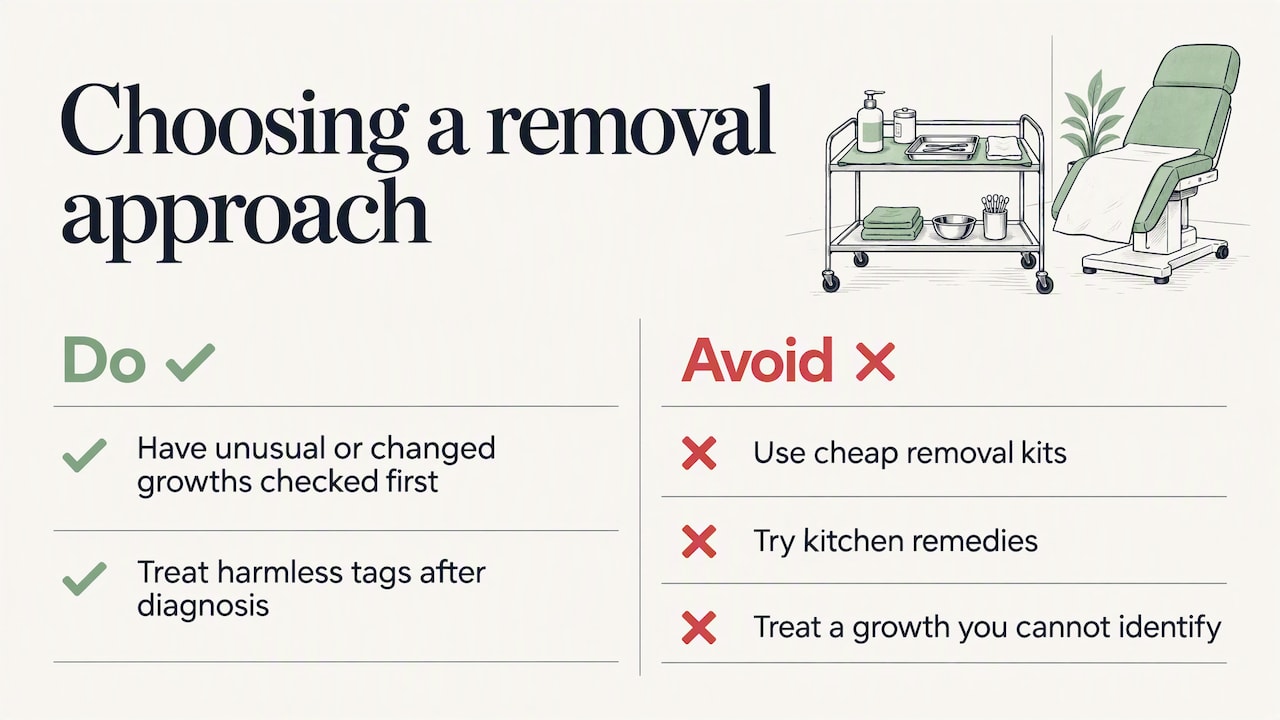
Two things guide how we work. First, our home-based spa in Ottawa is Health Canada licensed, and we treat that as a responsibility, not a slogan. Second, we would rather send you to a doctor than treat something we cannot confidently call a skin tag. If a growth looks unusual, has changed or worries you, get it checked first. We will be glad to treat the harmless ones afterwards.
What we do not recommend is the home approach. Cheap kits and kitchen remedies seem harmless, but a clean, quick treatment in a calm setting avoids most of the problems the health agencies warn about.
— Andy
What skin tag removal costs
In Canada, cosmetic removal is generally something you pay for yourself. Provincial plans typically cover medically necessary services, so check with your plan and your doctor if you think your case is medical. Prices for private clinics vary widely, depending on the provider, the method and how many tags you have, so ask for a written quote before you commit.
At Nakota MediSpa our published prices are:
| Treatment | Price |
|---|---|
| Skin tags | $25 per tag |
| Warts | $40 each |
| Cherry angioma, fibroma, milia and similar | $30 each |
| Appointment | $75 |
So, as an example, three skin tags would be 3 × $25 plus the $75 appointment, for a total of $150. Details are on our skin tag and wart removal page.
Skin tag removal at Nakota MediSpa in Ottawa
We treat skin tags, warts and small benign spots such as cherry angiomas, fibromas and milia in a private, home-based spa setting, with cryotherapy as our method. You get one-to-one time, a clear price per lesion and a straightforward conversation about what we can and cannot treat. If you also have rough, waxy spots and are unsure what they are, our guide to seborrheic keratosis removal explains how they differ from tags.
Ready to book? Start on our skin tag removal page, or visit Nakota MediSpa to see everything we offer.
How to choose a provider
Whoever you pick, a few questions separate a careful provider from a careless one:
- Do they look before they treat? A good provider examines the growth and will refer you if it looks unusual.
- Do they explain the method and risks? Scarring, marks and blisters should be mentioned honestly.
- Is the pricing clear? A per-tag price, plus any appointment fee, should be stated up front.
- Are the licence and devices in order? Ask about licensing, and check that any device used is authorized, as Health Canada advises.
- Is it hygienic? Clean tools, gloves and a clean room are not optional.
A doctor’s office and a licensed spa can both be reasonable choices for a clear-cut, small cosmetic tag. A doctor is the better first call for anything uncertain, changing or numerous.
FAQ
Will a skin tag come back after removal?
The tag that was removed will not regrow, but new ones can appear elsewhere, especially if the cause is ongoing friction or one of the risk factors such as weight, pregnancy or diabetes. If many keep appearing, talk to your doctor about why. Reducing rubbing from clothing or jewellery can help.
How do I make a skin tag drop off?
We do not recommend trying. Health agencies in Canada warn that clipping them off or applying lotions and pastes can cause bleeding, infection and scarring. A quick professional treatment is safer and cleaner.
Does removal hurt, and will it leave a scar?
You may feel a brief sting. Official guidance notes that removal procedures may hurt a little and can leave a scar or mark, and freezing may raise a small blister that heals on its own. Careful aftercare and protecting the area from sun and friction help the skin recover.
Is cosmetic skin tag removal covered by health insurance?
Generally, cosmetic removal is paid out of pocket. Coverage for medically necessary dermatology care depends on your province and plan, so ask your doctor or insurer if you think your tag causes a medical problem.
Sources
- Removing Moles and Skin Tags, MyHealth Alberta
- Removing Moles and Skin Tags, HealthLink BC
- Skin cancer, Canada.ca
- Health Canada reminds Canadians that plasma pens are unauthorized
- Skin tags, NHS
- Skin Tags (Acrochordons), Cleveland Clinic
- Skin tags: Why they develop, and how to remove them, American Academy of Dermatology
