Cryotherapy is a common clinic procedure that freezes benign skin tags with liquid nitrogen, so they typically scab and fall off within about 7 to 14 days. A professional should look at the growth first, and some tags need a repeat visit. If you want this done in person, we offer it at our spa.
TL;DR:
- Growths that change, bleed, look unusual, or appear in clusters need diagnosis before removal, because they may not be skin tags.
- People with darker skin face greater risk of lasting pigment changes, so clinicians may reserve freezing for necessary cases or choose another removal method.
- The clinic lists treatment at $25 to $40 CAD per lesion, with a separate $75 CAD charge for the appointment.
- Keep the treated area clean and dry, leave blisters intact when possible, and seek immediate care for spreading redness, warmth, swelling, or discharge.
- One trial found a cryogenic pen cleared 64.3% of lesions after up to three treatments, but home products can cause infection or bleeding.
Table of Contents
- How cryotherapy removes skin tags
- Who should consider clinic cryotherapy
- What happens during your appointment
- Healing timeline and aftercare
- Safety, pigment risk and home devices
- Why a clinic visit is usually the safer choice
- Book your cryotherapy appointment with us
- FAQ
- Sources
How cryotherapy removes skin tags
Cryotherapy works by freezing tissue until the cells in it are destroyed. Clinics usually use liquid nitrogen at −196°C, and ice forms inside the lesion so that new skin grows underneath once the dead tissue lets go.
Clinicians choose among a few techniques:
- Spray: liquid nitrogen is sprayed directly onto the tag, which suits small, flat growths.
- Contact: a cotton-tipped applicator or probe dipped in liquid nitrogen touches the tag, and cotton-tip contact tends to produce a shallower freeze than open spray.
- Cryopen: a pen-style device delivers a very cold, focused freeze to a small spot.
- Freeze then snip: for a larger tag, the base is frozen and the tag is then cut off with sterile scissors, a combination the American Academy of Dermatology describes among the common clinician methods.
In a small blinded randomized trial, people preferred contact cryotherapy for pain tolerance over electrocoagulation, although electrocoagulation gave better cosmetic results at 30 days for some lesions.
Healing usually takes 7 to 14 days. Some tags don’t clear in a single session, and the same hospital guidance notes that repeat treatments are sometimes needed.
Who should consider clinic cryotherapy
Most skin tags are harmless, and the NHS says they don’t usually need removal. Removal is generally cosmetic, so many people choose it for comfort or appearance. Treatment makes sense when a tag:
- Rubs on clothing or jewelry and gets irritated
- Bleeds or becomes painful
- Sits near the eye and affects vision
- Grows quickly, or you notice many new tags appearing
- Looks unusual enough that you aren’t sure what it is
That last point matters most. A growth that is changing, bleeding or oddly colored deserves a diagnosis before any removal, because dermatologists point to correct diagnosis as one of the main benefits of professional care.
Skip the DIY route. The NHS advises against removing tags yourself because of infection, bleeding and scarring risks, and dermatology guidance warns that over-the-counter removal products can cause infection and uncontrolled bleeding.
Skin tone also plays a role. People with darker skin have a higher chance of lasting pigment changes, so cryotherapy should be used only when necessary and may be swapped for another method, according to clinical guidance.
Pro Tip: Take a photo of any tag you’re unsure about and bring it to your appointment, so your practitioner can see whether it has changed.
What happens during your appointment
A typical visit follows a predictable order:
- Consultation: we review your medical history, including any medicines that raise bleeding risk, and examine the lesion.
- Consent: we explain the options and what healing will look like, and you agree to go ahead.
- Cleaning: the area is cleaned so the freeze goes onto clear skin.
- Freezing: the tag is frozen with spray or contact, usually for several seconds, until the tissue turns white.
- Optional snip: for a larger hanging tag, the base may be frozen first and the tag removed with sterile scissors.
- Aftercare briefing: you leave knowing how to protect the area and which changes to watch for.
Most single-tag treatments are quick, often over in minutes. You will likely feel stinging or burning while the cold is applied, then numbness, and afterward a dull ache that can last a few hours. Over-the-counter pain relievers such as paracetamol are commonly recommended.
Our cryotherapy for benign skin lesion removal is $25-40 CAD per lesion, with a $75 CAD appointment fee. Those are the published prices.
Healing timeline and aftercare
The treated tag changes in stages. Expect the skin to look pale or bleached first, then possibly form a blister or crust. A scab usually falls off within 7 to 14 days, though inflammation can linger for up to 6 weeks.
Aftercare is simple:
- Keep the area clean and dry.
- Leave a blister intact if you can, since it acts as a natural dressing.
- Don’t pick at the scab; let it detach on its own.
- If a blister becomes large or tense, seek prompt medical advice.
- If you notice spreading redness, warmth, swelling or discharge, seek immediate medical care.
If a tag is still there after the area has healed, we may suggest a second session. Stubborn or thicker tags are the ones most likely to need it.
Safety, pigment risk and home devices
Cryotherapy is a controlled cold burn, and hospital guidance describes it as generally safe with a few known risks:
- Pigment changes, which are more likely in darker skin
- Infection if the wound isn’t kept clean
- Scarring, including white patches
- Damage to the underlying skin
- Rarely, nerve damage
Careful technique, including controlling freeze depth and time, helps keep these risks down.
Home devices are a mixed picture. In a randomized trial, a cryogenic pen reached 64.3% complete disappearance after up to three treatments and beat a commercial comparator, which suggests colder temperatures work better. Even so, the authors’ point is that many over-the-counter devices are less cold and less effective than professional cryotherapy.
Dermatology and regulatory guidance both warn that at-home removal products can cause infection and uncontrolled bleeding.
Why a clinic visit is usually the safer choice
Skin tags look simple, and that is exactly why people skip the diagnosis. In our view, the examination is the most valuable part of the visit. A practitioner who checks the lesion first can spot the one that isn’t a skin tag, and that matters more than how the freeze is delivered.
Technique is the second piece. Freezing a small tag with controlled contact, or freezing the base and snipping a larger one, lets us match the method to the growth and your skin tone, which keeps pigment and scarring risks lower. If a lesion is changing, bleeding or unfamiliar, get it looked at before you treat anything.
— Andy
Book your cryotherapy appointment with us
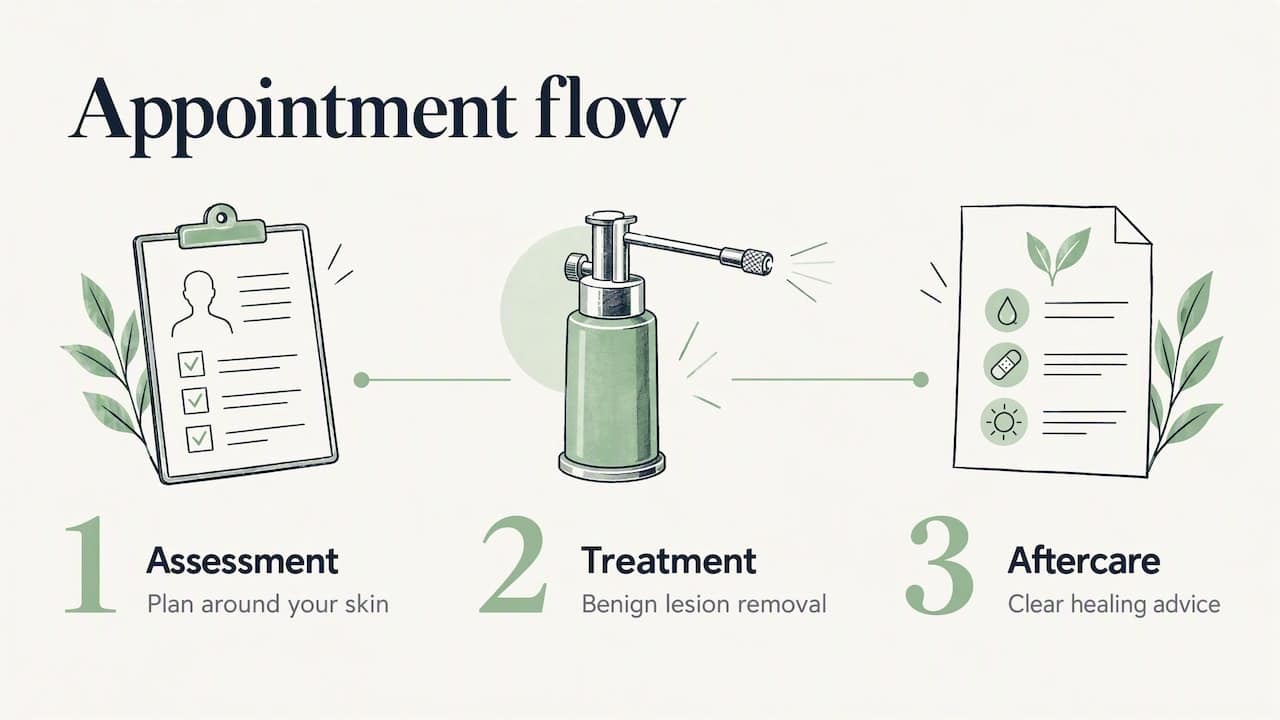
We offer cryotherapy for benign skin lesion removal in a private, home-based setting. Your visit starts with an assessment, moves to the treatment itself, and ends with clear aftercare advice, so you know what healing will look like before you leave. We plan each appointment around your skin.
Treatment is $25-40 CAD per lesion, plus the $75 CAD appointment fee. If you’re also interested in skin recovery support, ask us about micro-needling home care options for aftercare. To get started, book your cryotherapy appointment here.
This article is general information, not a substitute for advice from a qualified doctor. Consult a qualified healthcare professional about your own circumstances before acting on anything here.
FAQ
How long does a skin tag take to fall off after cryotherapy?
Most treated tags form a scab and fall off in roughly one to two weeks. Hospital guidance gives 7 to 14 days, and some inflammation can last longer.
Does cryotherapy for skin tags hurt?
You will usually feel a brief stinging or burning while the cold is applied, followed by numbness and then a dull ache for a few hours. Over-the-counter pain relievers are commonly recommended for the ache.
Is cryotherapy safe for darker skin?
It can be used, but the risk of lasting pigment changes is higher, so practitioners use it with caution and may choose another method. Clinical guidance advises cryotherapy for darker skin only when necessary.
Can I freeze a skin tag at home instead?
Home devices exist, but they are generally less cold and less effective than clinic cryotherapy, and the NHS advises against self-removal. A professional can also confirm the growth is a skin tag first.
Will a skin tag come back after cryotherapy?
Whether a tag returns or needs another session depends on the lesion and how it responds to treatment. New tags can appear elsewhere, so see a professional if you notice many at once.
Sources
- Cryotherapy – Leeds Teaching Hospitals NHS Trust
- Evaluation and Comparison of the Efficacy and Safety of Cryotherapy and Electrosurgery in the Treatment of Sebaceous Hyperplasia, Seborrheic Keratosis, Cherry Angioma, and Skin Tag: A Blinded Randomized Clinical Trial Study – PMC
- Cryotherapy – Resource Library – Sheffield Children’s NHS Foundation Trust
- [Skin tags
- NHS](https://www.nhs.uk/conditions/skin-tags/)
- Normal expected reactions: