
Cryotherapy removes a wart by freezing it with liquid nitrogen. It usually takes less than a minute per wart, but it rarely clears a wart in one visit. Most people need several sessions, and it works better on warts of the hands than on warts on the soles of the feet. This guide covers how it works, what the evidence says, what healing looks like and who should not have it. It also covers what it costs at our home-based clinic in Ottawa.
TL;DR
- Liquid nitrogen (about −196°C) freezes and destroys wart tissue, and may also prompt an immune response. The freeze itself takes under a minute.
- In a randomized trial, 49% of common warts were gone at 13 weeks with cryotherapy, versus 15% with salicylic acid and 8% with waiting. Plantar warts did not show the same advantage.
- Expect repeat visits every few weeks, a blister or scab, and a few days of tenderness.
- A lesion should be confirmed benign before it is frozen. Changing, bleeding or unusual bumps need a diagnosis first.
- At Nakota MediSpa, benign lesion cryotherapy is 25-40 CAD per lesion plus a 75 CAD appointment fee.
Table of Contents
- How cryotherapy removes a wart
- Does it work? What the evidence says
- Where the wart is changes the answer
- Should you treat it at all?
- Who should not have a wart frozen
- What happens at a cryotherapy appointment
- Healing and aftercare
- How many sessions will you need?
- Perspective: why we keep the consultation long
- Cryotherapy at Nakota MediSpa
- Other ways to treat warts
- FAQ
- Sources
How cryotherapy removes a wart
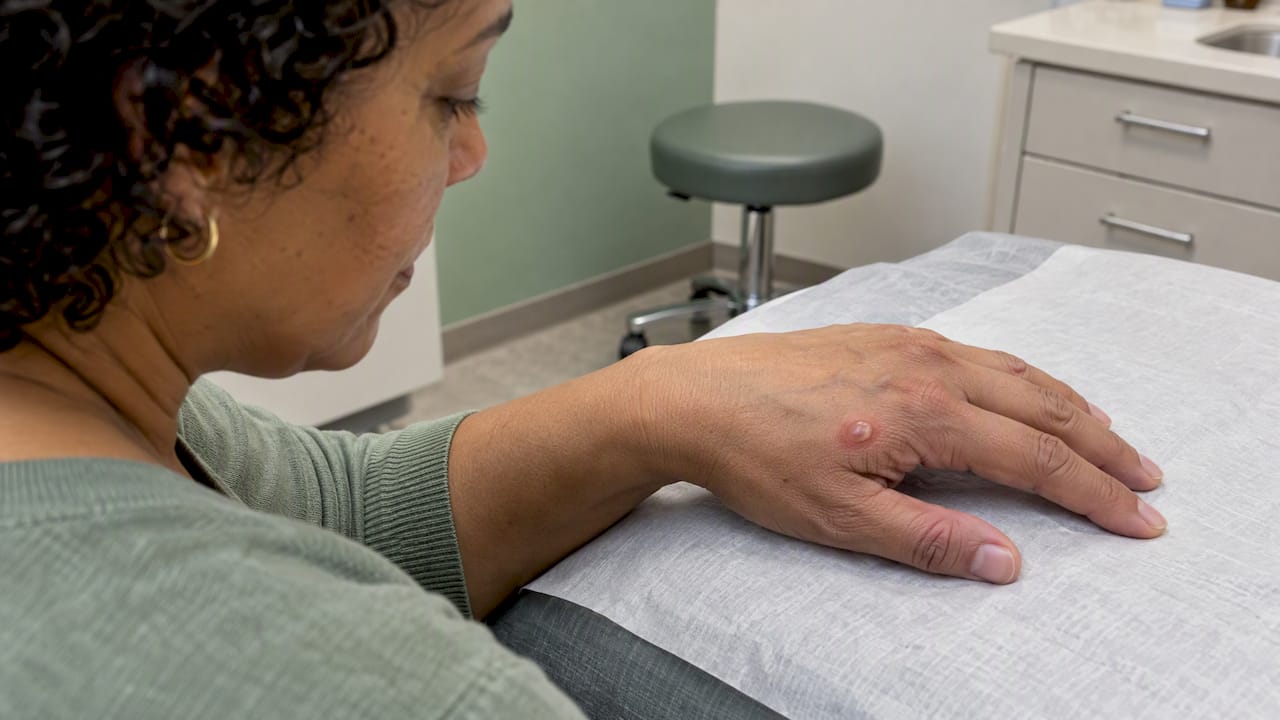
A wart is a skin growth caused by a virus (HPV). Cryotherapy uses extreme cold to damage the infected tissue. MedlinePlus describes the usual method: liquid nitrogen is applied with a dipped cotton swab or through a probe. It is done in a provider’s office and usually takes less than a minute.
The Canadian Agency for Drugs and Technologies in Health summarizes the goal. The cold destroys abnormal tissue, interrupts its blood supply and may stimulate the immune system. The same review notes that the best delivery method is still uncertain. A swab, a spray and a probe are all in use.
The cold feels like an ice cube pressed hard against the skin, followed by stinging as the area thaws. The area then reddens, and a blister often forms within hours.
Does it work? What the evidence says
The most useful number comes from a Dutch primary-care trial published in the Canadian Medical Association Journal. It enrolled 250 people aged 4 to 79 and compared cryotherapy every two weeks, daily salicylic acid and simple waiting.
| Treatment | Common warts cleared at 13 weeks |
|---|---|
| Cryotherapy | 49% |
| Salicylic acid | 15% |
| Waiting (no treatment) | 8% |
For plantar warts (on the soles), the differences between the three approaches were not significant. These are group results, not a promise for any one person, and the trial was not run in Ottawa.
Two more points matter:
- Many warts go away without treatment. The same paper notes that up to one-third of primary school children have warts, and two thirds of those resolve within two years.
- Cryotherapy is considered one of the best-studied options. A patient-information summary on NCBI Bookshelf says warts are often treated with salicylic acid or cryotherapy, and that these are the best-studied treatments.
Where the wart is changes the answer
This is the question we ask first: where is it?
- Fingers, hands, elbows, knees: Cryotherapy is a reasonable first professional option, especially if the wart is painful, bothersome or has not responded to self-care.
- Soles of the feet: Thick skin makes freezing more painful and less effective. Freezing alone is a weak choice here. Salicylic acid between visits is often discussed.
- Face: Facial warts generally call for a dermatologist’s assessment rather than routine freezing, because the skin is thin and scarring or colour change is more noticeable.
- Genital warts: These need a physician. Do not treat them as an ordinary skin wart.
The American Academy of Dermatology lists common, plantar and flat warts among the types dermatologists treat with cryosurgery during an office visit.
Should you treat it at all?
Sometimes the honest answer is no. Guidance from NICE says there is a strong case for not treating most warts, because they seldom cause symptoms and usually resolve on their own. Treatment can also hurt.
Freezing starts to make sense when a wart:
- hurts or catches on clothing, tools or shoes
- is spreading or multiplying
- is visible and bothers you
- has not cleared after weeks of salicylic acid
The same NICE guidance describes salicylic acid as an option applied daily for up to 12 weeks. It is cheaper and can be done at home, but it takes patience. Cryotherapy is faster to start and needs several visits.
Who should not have a wart frozen
Freezing destroys tissue. That makes two kinds of caution important.
Be sure it is a wart. Cryotherapy is not a biopsy, and frozen tissue cannot be examined under a microscope afterwards. The American Academy of Dermatology advises against treating a bump that is changing, bleeding or unusual as if it were a wart. See a family doctor or dermatologist first. This applies to any dark, irregular or fast-growing spot.
Check your health history. Extra caution or a specialist assessment is needed if you have:
- diabetes with foot problems, poor circulation or peripheral arterial disease
- nerve damage (neuropathy)
- Raynaud disease, cryoglobulinemia or cold urticaria
- an open wound or infection at the site
If any of these apply, speak to your family doctor or dermatologist before booking a freeze. This is especially true for a wart on the foot.
Skin tone also matters. Freezing can lighten or darken the skin, temporarily or permanently, and this deserves an upfront conversation if you have brown or Black skin. NICE flags pigment change and scarring as points to weigh when choosing a treatment.
What happens at a cryotherapy appointment
- Consultation. We look at the lesion, ask how long it has been there, whether it has changed, what you have already tried and where it is on your body.
- Decision. If it looks like a benign wart and freezing suits your health history, we go ahead. If anything seems atypical, we recommend a medical diagnosis first.
- Freezing. Liquid nitrogen is applied to the lesion for a few seconds. You feel intense cold, then stinging.
- Aftercare. You leave with instructions for washing, protecting the area and what to watch for.
- Follow-up. If the wart persists, a repeat session is scheduled.
Healing and aftercare
The area usually heals in about 4 to 7 days according to the American Academy of Dermatology. MedlinePlus notes that scab peeling can take 1 to 3 weeks depending on the site.
What to expect:
- Pain commonly lasts up to 3 days.
- Redness, swelling, a clear or blood-coloured blister, crusting and temporary numbness can all happen.
- A blister is an expected effect, not automatically an infection.
What to do:
- Wash gently once or twice a day and pat dry.
- Use a bandage if the spot rubs against clothing or could be knocked.
- Do not pick the scab or remove the blister roof unless your clinician says to.
Contact your provider if you notice spreading redness, warmth, pus, fever or worsening pain, or if the lesion does not resolve.
How long before you can swim?
There is no single official interval. Wait until the blister or scab is closed and no longer weeping. Many aftercare sheets use about one week for pools and hot tubs. Your clinician’s advice takes priority, especially after a large blister, a foot lesion or slow healing.
How many sessions will you need?
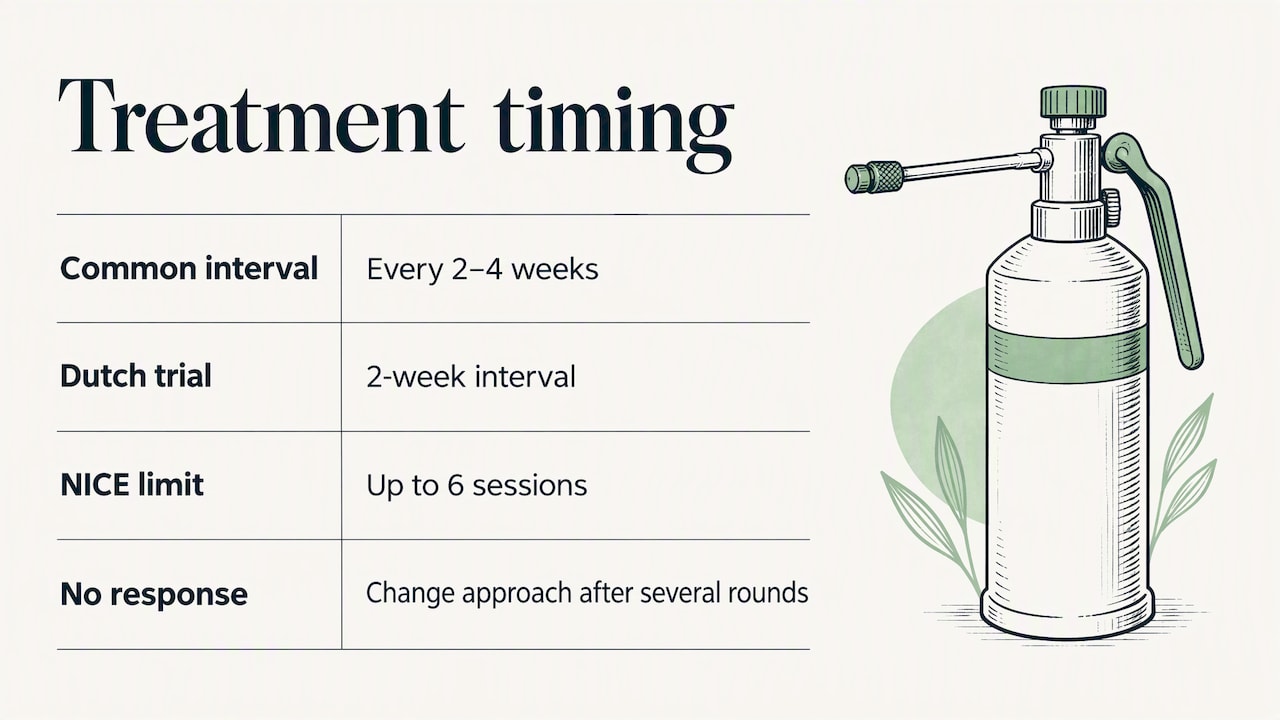
Most people need more than one. Dermatology guidance commonly repeats treatment every 2 to 4 weeks. The Dutch trial above used a two-week interval. NICE allows up to six sessions. If a wart has not responded after several rounds, it is reasonable to change approach rather than keep freezing.
Perspective: why we keep the consultation long
We run Nakota MediSpa from a private, home-based setting in Ottawa. That lets us spend real time with each person before any treatment. With warts, the most important work happens before the liquid nitrogen comes out.
We want to know where the lesion is, how long it has been there and whether it has changed. We also want to know your skin tone and your health history. A quick freeze is easy to perform. Knowing when not to freeze is the harder skill.
If a lesion looks unusual, we say so and send you to a doctor. If a wart is not bothering you, we will tell you that waiting is a legitimate choice. Freezing is a good tool for the right wart. We would rather you book once for the right reason than five times for a plantar wart that was never likely to respond.
— Andy
Cryotherapy at Nakota MediSpa
We offer cryotherapy for benign skin lesions, including warts and skin tags, at our home-based clinic in Barrhaven, Ottawa. Published prices:
| Item | Price |
|---|---|
| Cryotherapy, benign skin lesion removal | 25-40 CAD per lesion |
| Appointment fee | 75 CAD |
You can see details and book on our skin tag and wart removal page. Have a look at your lesion first. If it is changing, bleeding or you are unsure what it is, get it checked by a doctor before booking.
Other ways to treat warts
- Waiting: Reasonable for many warts, especially in children, though it can take up to two years.
- Salicylic acid: Applied daily for weeks. NICE lists preparations commonly in the 12 to 26% range.
- Physician-led options: A family doctor or dermatologist can offer other treatments for stubborn, widespread or plantar warts.
- Do-it-yourself freezing kits: WebMD notes that a professional will want to minimize scarring and can usually do a better job than a home product.
If you have a wart and a skin condition that complicates healing, ask your doctor which option is safest before choosing.
FAQ
How long does it take for a wart to disappear after cryotherapy?
The wart often blisters within hours, then scabs and sheds over roughly 1 to 3 weeks. Complete clearance often takes several sessions spaced a few weeks apart. Some warts, especially on the soles, are stubborn.
Is cryotherapy for warts painful?
It is uncomfortable. Expect sharp cold and stinging during the freeze, then tenderness that commonly lasts up to 3 days. Thick-skinned areas such as the soles tend to hurt more.
Can I pop the blister after freezing?
No. Leave the blister roof in place, wash gently and protect it from friction. If it grows very large, becomes very painful or shows signs of infection, contact your provider.
Does freezing leave a scar?
Scarring is uncommon but possible, and colour change can occur. It matters more on thin skin and on brown or Black skin. Tell your clinician beforehand so the treatment can be kept gentle.
Is cryotherapy better than salicylic acid?
For common warts, the CMAJ trial found higher clearance at 13 weeks with cryotherapy. For plantar warts, there was no significant difference. Salicylic acid is slower, but it can be done at home.
Sources
- Cryotherapy for the skin, MedlinePlus
- Cryotherapy, salicylic acid and waiting for warts, CMAJ
- Warts: diagnosis and treatment, American Academy of Dermatology
- Warts and verrucae management, NICE CKS
- Cryotherapy systems for wart removal, CDA-AMC
- Warts: treatment options, NCBI Bookshelf
- Cryotherapy for freezing warts, WebMD
