
A chemical peel can fade many kinds of hyperpigmentation, but it is not equally good for all of them. It works best on pigment that sits in the top layers of skin, such as sun spots and post-acne marks, and it needs several gentle sessions rather than one strong one. Melasma is stubborn and relapses, so it needs a slower plan and strict sun protection. Below we explain which peel suits which kind of pigment, how many sessions to expect, and why fall and winter are the right seasons to start in Ottawa.
TL;DR
- Peels remove pigmented surface skin and speed up renewal. They work best on superficial pigment: sun spots, post-inflammatory marks and epidermal melasma.
- Several light peels usually beat one aggressive peel, especially on medium to deeper skin tones, where overly strong peels can cause new dark marks.
- Melasma and post-inflammatory hyperpigmentation often come back. Daily sunscreen and maintenance are part of the treatment.
- Cooler months are the better time to peel. In Ottawa that means starting now rather than in June.
- A new or changing dark spot should be checked by a doctor before anyone treats it as a sun spot.
Table of Contents
- Why dark spots form and what a peel can reach
- Which peel for which kind of pigment
- Sun spots and sun-damaged skin: peel or something else?
- How many peels and how long until you see results
- Risks and who should be careful
- Prepping and protecting: the part that decides your result
- Why timing matters in Ottawa
- Our perspective: why we start gently
- Chemical peel and pigment care at Nakota MediSpa
- Preparing for your first appointment
- FAQ
- Sources
Why dark spots form and what a peel can reach
Hyperpigmentation is extra melanin deposited in the skin. The usual causes are sun exposure, inflammation (acne, a scratch, a previous peel or laser) and hormonal shifts, which is the typical story behind melasma. A 2021 review of managing facial hyperpigmentation in skin of colour notes that post-inflammatory hyperpigmentation and melasma are common, mostly benign and affect all skin types.
Depth decides how well a peel will work:
- Epidermal pigment (sun spots, freckle-like marks, many post-acne marks) sits near the surface. Peels reach it well.
- Dermal pigment sits deeper. A peel strong enough to reach it risks harming darker skin, so experts discourage aggressive peels for dermal melasma in darker skin and aim for epidermal improvement instead.
- Mixed pigment is common. Expect partial improvement and a longer plan.
Here is the idea in plain terms. A peel removes damaged surface cells, but pigment is produced by cells in the new skin underneath. If the trigger (sun, inflammation, hormones) is still active, the spots can return. That is why the after-care matters as much as the peel.
Which peel for which kind of pigment
There is no single best peel for hyperpigmentation. The right one depends on your pigment type, skin tone and how your skin has reacted before.
| Concern | What usually suits | What to watch |
|---|---|---|
| Sun spots and general sun damage | A series of superficial peels, often with a brightening home routine | Flat brown spots that look unusual need a doctor’s eye first |
| Post-acne marks (PIH) | Gentle superficial peels, sometimes with acne-friendly acids | Over-peeling can add new marks |
| Melasma | Light peels at low strength, repeated, plus sun protection and topical therapy | High relapse rate; avoid heat and aggressive strength |
| Skin of colour | Lower-strength agents, patch or spot testing, and skin preparation beforehand | Risk of PIH rises with depth |
The research on specific acids is consistent. A meta-analysis of peels for melasma in dark-skinned patients found glycolic acid and trichloroacetic acid (TCA) the most studied agents. Glycolic acid is often cited for safety and efficacy as a superficial peel. TCA is typically used at lower concentrations, 10 to 25%, in darker skin types to reduce the risk of scarring or PIH. The same article reports that salicylic acid in ethanol is well regarded for dark-skinned patients, a point echoed in expert reviews of peels for melasma in this group.
The wider evidence has limits. A 2024 systematic review of chemical peels for melasma describes peels as a well-known way to accelerate treatment of a chronic, relapsing condition. It does not describe them as a cure. Treat any promise of permanent removal with suspicion.
Sun spots and sun-damaged skin: peel or something else?
Many people arrive asking for a facial for sun damage or a way to remove sun spots on the face. A peel is one tool. For diffuse sun damage (rough texture, dullness, scattered spots), a course of superficial peels works well, and it can be combined with other non-invasive treatments such as an exfoliating and oxygenating facial or radio-frequency tightening for the skin quality side of the problem.
A word of caution on discrete spots. A freckle-like brown spot that is new, growing, uneven in colour, bleeding or itchy should be looked at by a family doctor or dermatologist before anyone treats it. Skin cancer can look like a harmless age spot, and a peel is not a diagnosis. Treating something that was never checked is the wrong order of operations.
How many peels and how long until you see results
One common range: mild sun damage or light post-inflammatory hyperpigmentation typically improves with about 3 to 6 light peels, spaced a few weeks apart. We cannot verify that figure for every skin type, so treat it as a planning range, not a promise. Your own number depends on pigment depth, skin tone and how well you protect your skin between visits.
Set expectations honestly:
- Results build. Dermatology consensus says patients should be told that results are not immediate and need long-term maintenance.
- Skin may look worse before it looks better. Flaking and temporary darkening of spots are normal with superficial peels.
- Recurrence is common. Melasma and PIH have a high recurrence rate, which is why daily photoprotection and ongoing topical therapy are considered mandatory afterwards.
Risks and who should be careful
The main risk is the one you are trying to treat. The Mayo Clinic notes that a chemical peel can leave skin darker (hyperpigmentation) or lighter (hypopigmentation). Other issues include redness, irritation and, with deeper peels, scarring.
Tell your practitioner before treatment if any of these apply:
- Cold sores (herpes simplex). A peel can trigger an outbreak. Health Canada’s notice on peel products says a thorough medical history, including questions about HSV infection, should come before any peel.
- Recent isotretinoin, retinoid or other active use. Your practitioner needs to know what is on your skin and what you are taking.
- Pregnancy or breastfeeding. Ask your doctor first, and mention it at your consultation.
- A history of dark marks after injuries or acne. This points to a gentler, slower plan.
- Active sunburn, open wounds or skin infection. Wait until skin has healed.
The same Health Canada notice describes high-concentration acid peels as complex procedures that are best performed or supervised by dermatologists or plastic surgeons. If you want a deep or medical-strength peel, or you have a complicated pigment history, see a dermatologist. Superficial peels are the kind we offer, and part of our job is to tell you when your skin needs a physician instead.
Prepping and protecting: the part that decides your result
For skin of colour, experts describe priming the skin for weeks before a peel with topical agents such as retinoids or hydroquinone to cut the risk of PIH. In Canada, hydroquinone above 2% needs a prescription, and Health Canada warns that high-concentration products should only be used under a health professional’s supervision because of side effects including irritation and disfigurement. Do not order strong skin-lightening creams online. Health Canada has seized unauthorized skin-whitening creams labelled to contain a prescription drug. Ask your doctor or pharmacist about priming products.
Sun protection is the other half:
- Wear broad-spectrum sunscreen every day, including in winter and on cloudy days. The Canadian Dermatology Association’s Sun Protection Program lists recognized sunscreens with SPF 30 or higher and broad-spectrum coverage.
- For melasma and darker skin, consider an iron oxide-containing sunscreen. The skin-of-colour review above says these protect better against visible light, a known contributor to pigment returning, than mineral-only formulas.
- Do not pick flaking skin, and avoid sun, saunas and hot yoga while skin is healing.
Why timing matters in Ottawa
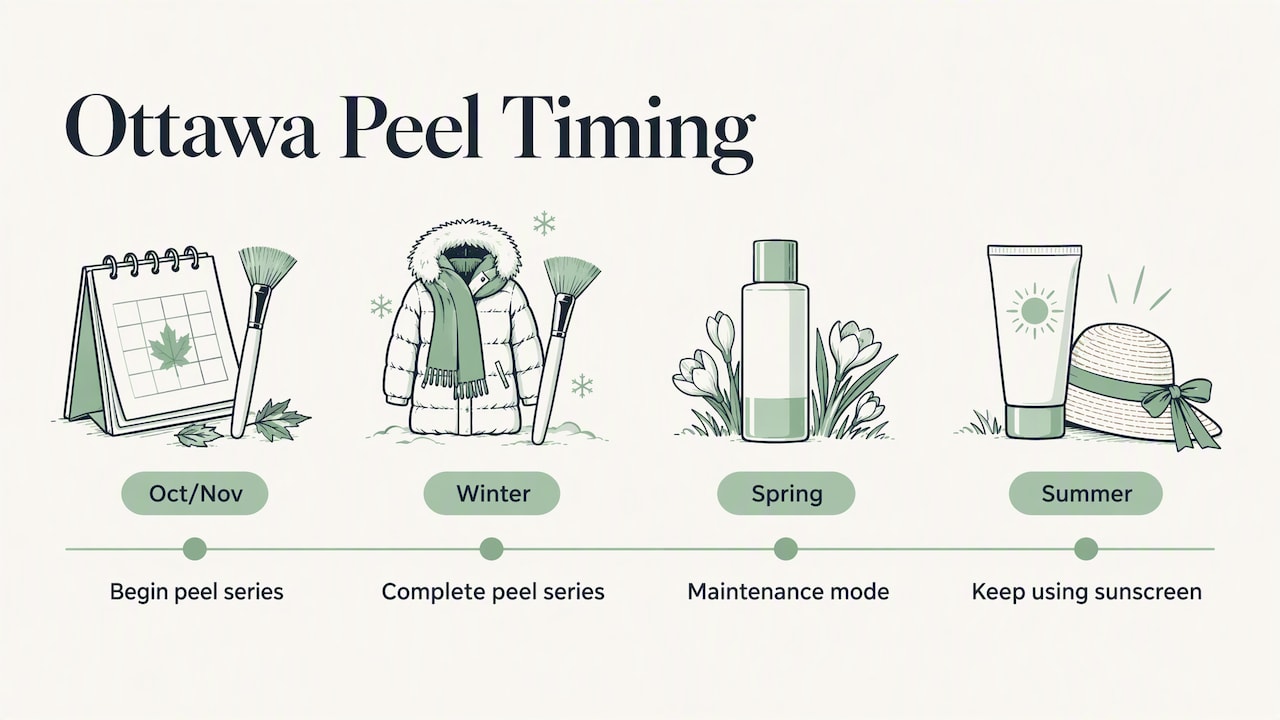
Post-peel skin is more sensitive to UV. Experts advise against aggressive peels in peak sun months and suggest waiting for cooler months to prevent induced hyperpigmentation. For us in Ottawa, a plan that starts in October or November lets you complete a series of peels over winter, when UV is lower and you are less often outdoors in strong light. By spring you can be in maintenance mode, ahead of the summer sun that darkens spots again. Sunscreen is still required.
Our perspective: why we start gently
We are a small, home-based spa, and that shapes how we handle pigment. Most of the hyperpigmentation we hear about is not one problem. It is sun history, old acne marks and sometimes hormones, all in the same face. So we spend time on the consultation before choosing anything: your skin tone, your history of dark marks, what you use at home, and whether the pigment looks superficial or deep.
We lean toward superficial, repeated treatment and away from “one big peel” promises. It is slower, but it protects you from the main danger, a peel that creates new pigment. Where it makes sense we pair peels with other non-invasive treatments for texture and glow. If a spot looks unusual, we send you to your doctor rather than treat it. We would rather lose a booking than treat something that needed a diagnosis.
— Andy
Chemical peel and pigment care at Nakota MediSpa
We offer the NOON chemical peel treatment in Ottawa, delivered in a private setting using Health Canada licensed devices and a thorough consultation. Pricing for the peel is not published, so please contact us for details. Depending on your skin, we may also discuss micro-needling (collagen induction therapy), $350 CAD, or an OxyGeneo 3 in 1 Super Facial for overall skin quality.
For small, clearly benign raised lesions such as skin tags or warts, we offer cryotherapy at $25 to $40 CAD per lesion plus a $75 CAD appointment fee. That is a different treatment from pigment fading, and flat brown spots should be assessed by a doctor first.
Preparing for your first appointment
- List your skin history. Note acne, cold sores, previous peels or lasers, and how your skin reacted.
- Bring your product list. Include prescription creams, retinoids and acids.
- Stop picking and tanning. Avoid sunburn and tanning beds in the weeks before.
- Plan the schedule. A series of sessions over a few months works better than one visit.
- Buy your sunscreen first. You will need it every day from the first session.
FAQ
Are chemical peels good for hyperpigmentation?
Yes, for the right type. They suit superficial pigment such as sun spots, post-acne marks and epidermal melasma. Deep or mixed pigment improves less, and melasma often returns without sun protection and maintenance.
Which is the best peel for hyperpigmentation?
There is no single best one. Glycolic, salicylic and low-strength TCA peels are the most studied, and the right choice depends on your skin tone, pigment depth and history. A light peel repeated over several sessions is usually safer than a strong one, especially on darker skin.
Can a chemical peel treat melasma?
It can help, as one part of a plan. Melasma is chronic and relapsing, so peels are combined with daily sunscreen and topical therapy, and results need maintenance. Ask a dermatologist if your melasma is stubborn, widespread or hormone-related.
When should I get a peel for sun spots?
In fall or winter, when UV is lower. Peeled skin is more sensitive to the sun, so avoid starting a series in summer. Have any new or changing spot checked by a doctor first.
Sources
- Efficacy and tolerability of chemical peeling for melasma in dark-skinned patients (PubMed)
- Chemical Peels in Melasma: Indian Pigmentary Expert Group consensus (PMC)
- Dermatology: how to manage facial hyperpigmentation in skin of colour (PMC)
- Chemical Peels for Melasma: A Systematic Review (PubMed)
- Melasma diagnosis and management across ethnic populations (systematic review)
- Health Canada: Prescription Drug List notice, multiple additions
- Health Canada reminds Canadians about high-concentration hydroquinone
- Health Canada seizure of unauthorized skin-whitening creams
- Canadian Dermatology Association: Sunscreen
- Mayo Clinic: Chemical peel
- Byrdie: how to fix sun-damaged skin
