
A radiofrequency (RF) facial warms the deeper layers of your skin to prompt it to tighten and rebuild collagen, with no incisions and no recovery period. The real benefits are firmer-feeling skin, softer fine lines and better texture, built up over a series of sessions. The results are modest compared with surgery. This guide covers what the evidence supports, who tends to respond best, what the risks are, and what to ask before you book.
TL;DR
- RF heats the dermis and the tissue beneath it, which stimulates collagen and elastin production and gives a gradual tightening effect.
- Typical benefits: firmer skin, smoother texture, softer fine lines and wrinkles, and a lifted look around the jawline, eyes and brows, without surgery.
- Results are usually modest, and younger skin generally responds better than older skin. A good provider will say so at the consultation.
- RF is safe for a wide range of skin tones, but burns and other injuries happen when the operator or the settings are wrong. Operator skill matters as much as the device.
- In Ottawa, our TriPollar® lift treatments start at 225 CAD for a full face.
Table of Contents
- How radiofrequency tightens skin
- The main benefits of RF facials
- Who sees the best results
- Realistic results and how many sessions
- Safety: what Health Canada says
- Home RF devices: do they work?
- Our perspective
- RF-based treatments at Nakota MediSpa
- How to prepare and what to expect
- Questions to ask any provider
- FAQ
- Sources
How radiofrequency tightens skin
RF devices send electromagnetic energy into the skin. The skin resists that energy, and the resistance turns into heat. Unlike a laser or intense pulsed light, RF does not rely on a pigment to absorb the energy, so it works on dermal tissue directly.
According to a review in Aesthetic Surgery Journal on the use of RF in aesthetic surgery, heat applied to the skin and the soft tissue under it produces contraction in two ways. The first is immediate: heat breaks hydrogen bonds in the collagen triple helix, so the fibrils shorten and thicken. The second is slower: the controlled injury prompts the body to remodel and lay down new collagen over the following weeks.
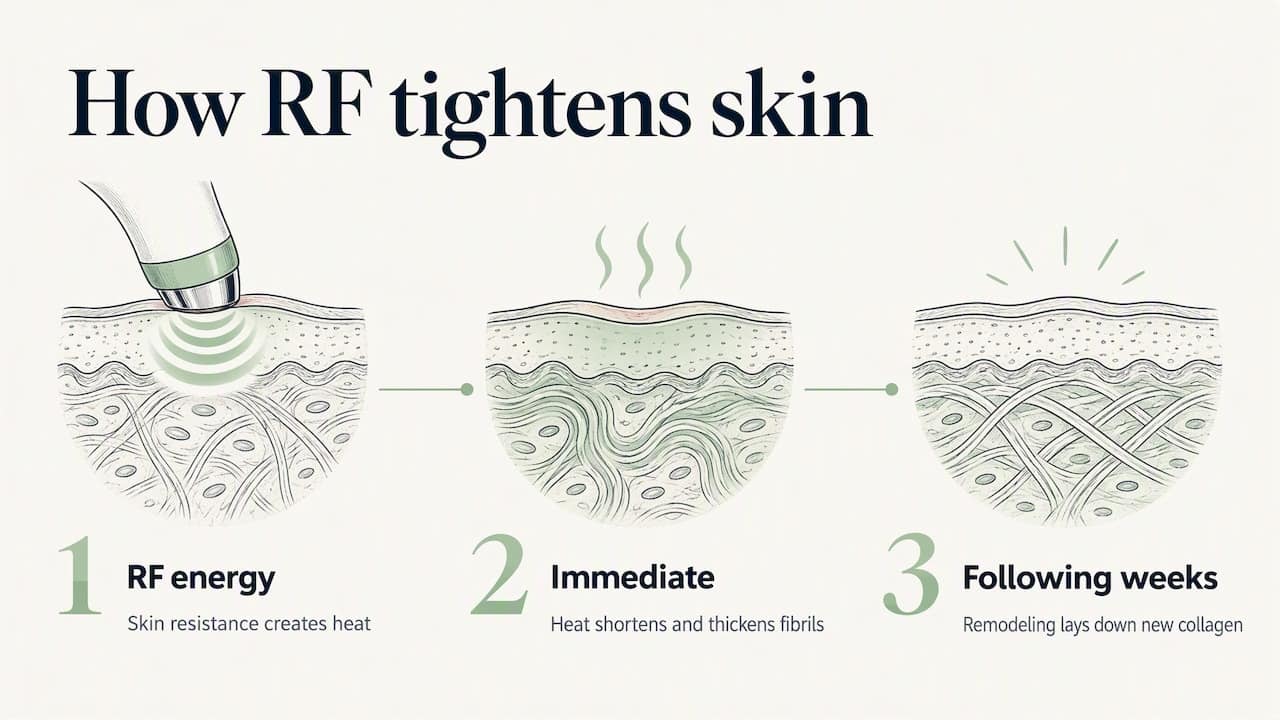
That two-step process explains what people notice. Some feel a little tighter right after a session. The more lasting change builds across several weeks and a course of treatments.
Monopolar, bipolar and tripolar
You will see these terms on menus. In simple terms, they describe how the current travels between electrodes, and that determines how deep the heat goes. Monopolar devices send energy deeper. Bipolar devices keep it shallower and between two close electrodes. Tripolar designs, such as the TriPollar® technology we use, combine several electrodes to spread the energy in the upper layers of the skin. The names matter less than whether the provider tailors depth and temperature to your face.
The main benefits of RF facials
Skin tightening and firmness
This is the headline benefit. A comprehensive review of RF in facial rejuvenation describes the technology as a key treatment because it induces collagen remodeling, improves skin laxity and enhances overall texture with minimal downtime. Firmness is the quality people most often notice first: cheeks that sit better, a jawline that looks cleaner, a less crepey neck.
Softer fine lines and wrinkles
Home-use studies give a useful window on this. In a 12-week study of 47 participants using a handheld multisource RF device, researchers measured wrinkle reduction and improvements in skin tone, elasticity and dermal collagen content. A randomized split-face trial found that a home-use RF device outperformed standard anti-aging cosmetics on wrinkles, radiance, color and skin thickness (p < 0.05). Professional treatments use stronger devices than these, but the studies show the direction of the effect.
Better texture and radiance
Collagen remodeling does more than tighten. Skin tends to look smoother and brighter as the structure underneath improves. That is why many clients book RF-based treatments as an overall refresh and not only for a specific sagging area.
Targeted lifting around the eyes and brows
The thin skin under the eyes and along the brow is one of the first places people notice aging. We offer a dedicated TriPollar eye-area and eyebrow lift at 100 CAD, because these zones need lower energy and more careful handling than cheeks or jawline.
No surgery and little downtime
Experts in aesthetic dermatology describe RF as a bridge for people who want improvement but are not candidates for surgery, or simply do not want it. You can usually go back to normal activities right after. Mild redness and warmth are common, and they typically settle within a day, according to the research summarized in the Health Canada notice we cite below.
Suitable for many skin tones
Because RF acts on dermal tissue and not on pigment, clinicians describe it as relatively color-blind. A dermatology review of RF in facial rejuvenation makes this point, and it is one reason RF is often considered for darker skin tones where light-based treatments call for more caution. It does not mean any person can be treated with any setting. It means the pigment is not the limiting factor.
Who sees the best results
Age matters. The same review notes that younger patients often respond more favorably, because their collagen has not yet reached the advanced cross-linking common in later aging. Older collagen is less responsive to the moderate heat RF provides.
In practice:
| Situation | What to expect |
|---|---|
| Early signs of aging: mild laxity, fine lines, dull texture | The best fit. Gradual, visible improvement is realistic. |
| Moderate laxity: early jowls, softening jawline | Visible improvement is possible, usually modest, and a course of sessions is likely. |
| Significant sagging or heavy skin folds | RF alone is unlikely to deliver a surgical-level lift. A consultation should be honest about this. |
This is why the consultation is the most important part of the process. Experts describe setting realistic expectations, modest versus dramatic, as the single most important part of pre-treatment discussion.
Realistic results and how many sessions
Satisfaction with RF is generally high, but the change is typically described as modest compared with a surgical facelift. Think of it as a better version of your own face, not a different one.
A few things shape the outcome:
- Number of sessions. The clinical studies above used repeated treatments, in the home-use trials as often as two to three times per week with low-energy devices. Professional treatments are spaced differently, and your provider should lay out a plan based on your skin and the device.
- Timing. Collagen takes weeks to build. Judging results on the day is not a fair test.
- Your starting point. Skin quality, age, sun history and habits all play a part.
- Maintenance. Sun protection and a good routine protect the investment.
Treat any promise of dramatic, permanent results as a warning sign.
Safety: what Health Canada says
RF is generally considered safe when done properly, but heat is heat. Health Canada has published a notice on the risk of thermal harm from energy-based medical devices, including devices used for cosmetic treatments. It points to risks such as burns and scarring, and says that improper technique, excessive energy or non-stationary application can lead to lasting damage. It defines an unsafe skin temperature as above 45°C without rigorous scientific justification.
What this means for you:
- Check that the device is licensed in Canada for the procedure being performed. Ask. A reputable provider will answer without hesitation.
- Ask who is operating it and how they were trained. Outcomes depend heavily on operator skill, including adjusting energy by facial zone. Thinner areas such as the temples and forehead need lower settings.
- Expect constant movement of the applicator. Professional devices are designed to avoid pulse stacking, which can overheat deeper tissue.
- Speak up about heat. Your sensations are real-time feedback. Warm is normal, sharp or burning is not.
- Be careful with numbing cream. It makes treatment more comfortable but it also masks your pain response, which is a safety signal.
RF microneedling is a different category
RF microneedling combines needles with RF energy. Health Canada’s Health Product InfoWatch for January 2026 discusses its potential risks, which are distinct from non-invasive RF tightening, including fat loss and nerve injury. If a provider suggests RF microneedling, ask about these risks and about the specific device’s licence. If you have any health condition, are pregnant, have an implant or pacemaker, or take medication that affects your skin, speak with your physician or dermatologist before booking any RF treatment.
Home RF devices: do they work?
The evidence says some do, within limits. The randomized trials mentioned earlier, including a 12-week open-label trial of a home-based RF device found improvements in wrinkles and skin quality with minimal pain and only transient mild redness. Home devices deliver much less energy than professional ones, so changes tend to be subtler and need consistent use over weeks.
The trade-off is control. At home, nobody adjusts settings to your anatomy or watches your skin for signs of overheating. Follow the manufacturer’s instructions exactly, never stay in one spot, and stop if you feel sharp heat. If you want a stronger, supervised result, professional treatment is the better route.
Our perspective
We see RF as one of the most useful tools for people who want to look rested and firm without surgery, as long as it is paired with honest advice. In our home-based studio in Ottawa, the consultation comes first. We look at your skin, your goals and your history, then decide whether RF is the right tool or whether something else would serve you better, such as micro-needling for texture and scarring or an OxyGeneo facial for overall skin quality.
We care about two things in particular. First, personalization: the same energy does not suit every face, and a private setting gives us the time to adapt as we work. Second, safety: we use Health Canada licensed devices and keep the applicator moving. We would rather tell you that a result will be modest than promise something skin cannot deliver.
— Andy
RF-based treatments at Nakota MediSpa
Our radio-frequency option is TriPollar® skin tightening in Ottawa. Current published prices:
| Treatment | Price |
|---|---|
| TriPollar® Lift, full face | 225 CAD |
| TriPollar Ultra Lift, face and neck | 275 CAD |
| TriPollar eye-under treatment or eyebrow lift | 100 CAD |
If your main concern is texture, scarring or fine lines more than laxity, collagen induction therapy (micro-needling) at 350 CAD may suit you better. For a deep-cleansing, exfoliating and nourishing facial, see our OxyGeneo 3 in 1 Super Facial. Many clients combine approaches over time, and we will tell you if a combination makes sense for you.
Not sure where to start? Book a consultation through our website and we will recommend a plan based on your skin.
How to prepare and what to expect
Before. Come with clean skin if possible and tell us about medications, skin conditions, recent sun exposure, implants and any previous cosmetic treatments. Avoid a sunburn before your visit.
During. The applicator glides across the skin in continuous motion. You should feel warmth that builds gradually and stays comfortable. Tell us right away if it feels too hot, because we adjust in real time.
After. Mild redness and a warm feeling are common and typically resolve within 24 hours. Use sunscreen daily and keep your skin hydrated. Contact your provider or physician if you notice blistering, lasting swelling, numbness or unusual pain.
Over the following weeks. Collagen remodeling continues. Take photos in the same light before you start and a few weeks after your course, so you judge by evidence and not memory.
Questions to ask any provider
- Is this device licensed by Health Canada for this specific treatment?
- Who will perform it, and what training do they have?
- How do you adjust energy for different areas of my face?
- How many sessions do you recommend, and what result is realistic at my age and skin type?
- What are the risks for me in particular, and what do I do if something goes wrong?
A confident, careful provider enjoys these questions. Vague answers are your cue to go elsewhere.
FAQ
How does radiofrequency tighten the skin?
RF heats the deeper layers of skin. The heat makes existing collagen fibrils contract and also triggers the body to produce new collagen and elastin over the following weeks. The review in Aesthetic Surgery Journal describes both the immediate and the delayed mechanism.
What are the side effects of RF facials?
The common ones are mild redness and swelling that typically settle within about a day. Rarely, improper technique or excessive energy can cause burns, scarring or deeper tissue damage, as Health Canada warns. Choosing a trained operator and a licensed device lowers that risk. See a physician if you develop blistering or lasting pain.
Are the results of an RF facial permanent?
No. Collagen production slows again as you age, and sun exposure speeds the decline. Most people maintain results with occasional follow-up sessions and consistent sun protection. Your provider should explain the likely timeline for your skin.
Is RF better than micro-needling or a facelift?
They do different jobs. RF is mainly for tightening and firmness, micro-needling for texture, scars and fine lines, and surgery for significant sagging. Experts describe RF results as modest compared with a surgical facelift, so the right choice depends on how much change you want and how much downtime you accept.
Sources
- Risk of thermal harm from energy-based medical devices, Health Canada
- Health Product InfoWatch, January 2026, Health Canada
- The Use of Radiofrequency in Aesthetic Surgery, PMC
- Radiofrequency in Facial Rejuvenation: A Comprehensive Review
- Radiofrequency in facial rejuvenation, International Journal of Dermatology and Venereology
- 12-week study of a multisource RF home-use device, PubMed
- Home RF device randomized split-face clinical trial, PMC
- Home-based RF device for facial rejuvenation, open-label trial, Journal of Cosmetic Dermatology
